Decision intelligence
Beyond ROI: Why AI Product Managers Should Measure Return on Decisions
Enterprise AI should be evaluated by how it changes organizational judgment, not only by what it removes from a cost line.
Written by Vanya Sahi
The missing measure
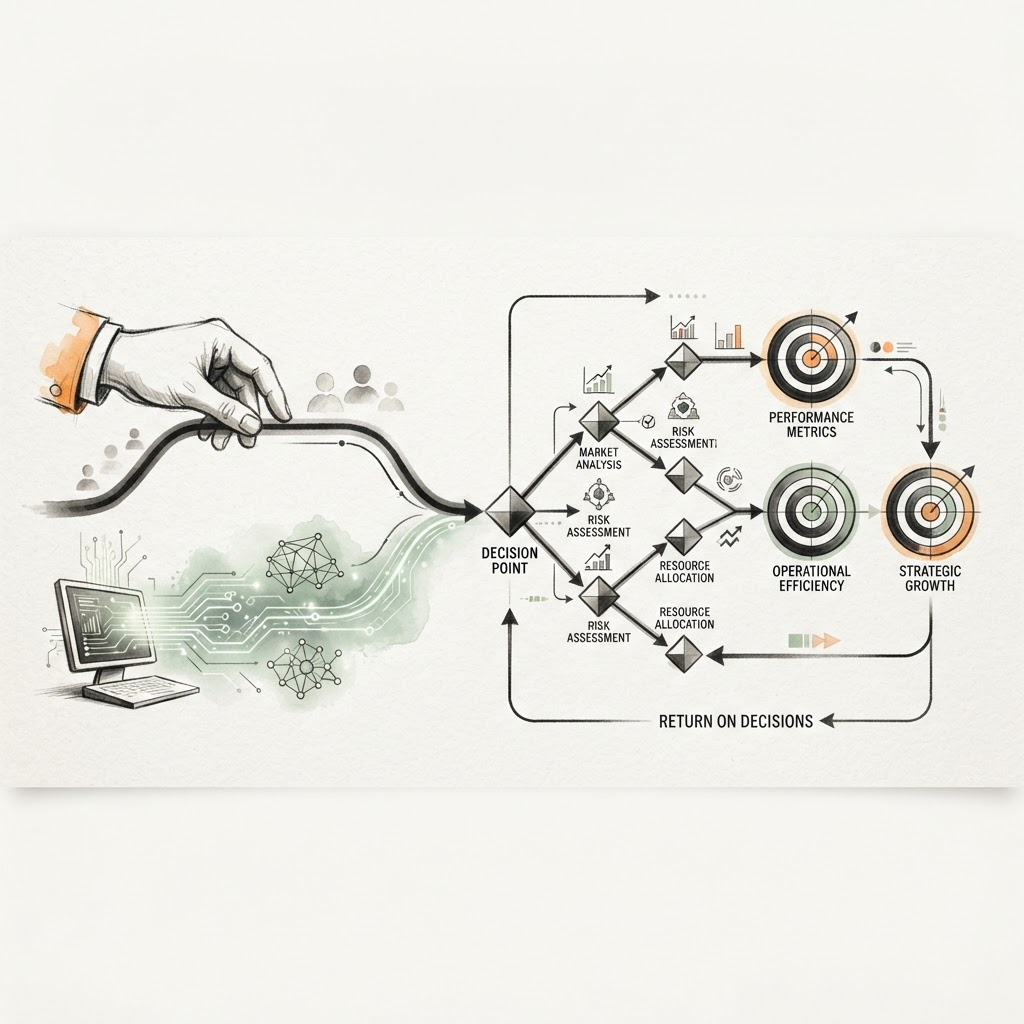
ROI is useful, but it is incomplete for systems whose value is distributed across many decisions. An AI capability can create financial value, improve decision quality, build organizational learning, or give a team strategic advantage before those effects appear in a simple savings calculation.
Trust is an economic variable
Trust affects adoption, escalation, review effort, and the willingness to act. Automation bias can create the opposite problem: fast decisions that are less resilient because people stop questioning the system. Product design must make confidence and uncertainty visible.
A value lifecycle
Return on Decisions can be measured across the lifecycle: time to decide, quality of evidence, confidence calibration, reversibility, learning after an outcome, and the organization’s ability to adapt. The goal is not to automate judgment away, but to make judgment better supported.
Decision resilience
Agentic AI raises the stakes. As systems plan and act, governance must account for delegation, exceptions, oversight, and the consequences of a wrong decision. A resilient product makes the path from signal to action inspectable.
Conclusion
The enduring question is not whether AI was added, or even whether it saved money. It is whether the organization makes better decisions because the system exists—and whether that improvement persists when conditions change.