AI Pulse / Proactive AI
The Proactive AI Problem: Designing Products That Know When Not to Ask
Demystifying the Meta Muse and the product decisions behind safe, useful anticipation
Written by Vanya Sahi / Sept. 12, 2026
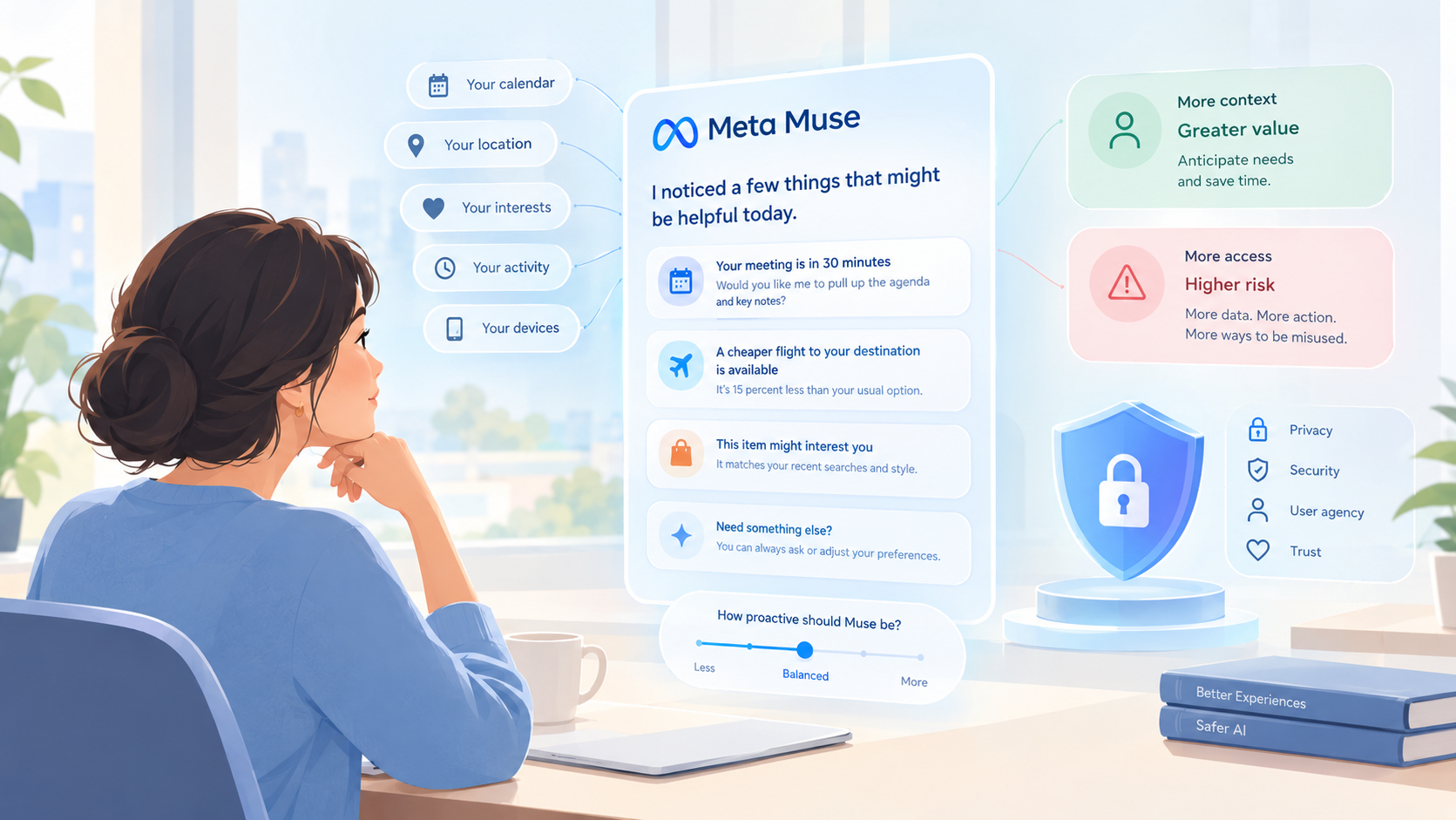
THE PROACTIVE AI PROBLEM: DESIGNING PRODUCTS THAT KNOW WHEN NOT TO ASK [DEMYSTIFYING THE META MUSE]
Picture a calendar assistant that notices you have a flight at seven in the morning and quietly moves your eight a.m. meeting without telling you. Most people would call that helpful, right up until the one time it moves the wrong meeting, or the one time it reveals to a colleague that you were traveling when you had told them you would be in the office. The same feature that feels like magic on a good day feels like a violation on a bad one. That gap, between delight and intrusion, is where the entire future of proactive artificial intelligence will be decided, and it is where product teams are now doing their most consequential work.
For most of software history, products waited. A person opened an app, typed a request, and the system responded. The product team designed the response. That model is quietly dissolving. The new generation of AI systems does not wait for a prompt. It watches your inbox, your calendar, your location, your purchase history, and your conversations, and it tries to figure out what you need before you ask for it. When that works, it feels like having a brilliant assistant who already knows you. When it fails, it feels like being managed by a system you never agreed to trust with that much of your life.
Meta's new personal agent, Muse, is one of the clearest real world examples of this shift, and it makes an unusually good case study because Meta has been unusually explicit about the tradeoffs it is making. Muse is not a chatbot bolted onto a messaging app. It is designed to run in the background, connect to a person's email, calendar, payment methods, and other everyday services, and carry out multi step tasks such as booking travel, negotiating a bill, filling out a school permission slip, or building a shortlist of vendors for an event. Meta has described it as a personal agent that works continuously to get things done rather than a tool a person consults occasionally. That is a meaningfully different product category than a search box with a personality, and it deserves to be examined on its own terms rather than folded into the general conversation about AI assistants.
WHY ANTICIPATION IS A DIFFERENT PRODUCT PROBLEM THAN RESPONSE
When a product only responds to explicit requests, the boundaries of its authority are set by the request itself. If you ask an assistant to draft an email, it drafts an email. The scope of the interaction is obvious to everyone involved. Proactive systems do not get that clarity for free. They have to decide, on their own, whether a given moment calls for silence, a suggestion, or an action, and they have to make that judgment using signals the user never explicitly provided.
This is why anticipation is not simply a smarter version of response. It requires the system to hold a model of the user's goals, preferences, and tolerance for interruption, and it requires the product team to make decisions about what the system is allowed to infer and what it must confirm. A product manager working on a reactive tool asks, does this feature do what the user asked. A product manager working on a proactive system has to ask a harder question: should this system have acted at all, and did it correctly judge that this was a moment where acting mattered more than asking.
Meta's own framing of Muse leans directly into this tension. The company has said that users choose which apps and services Muse can access and can disconnect them at any time, and it has built a permission layer that is meant to sit between the agent's judgment and the actions it can actually carry out. That layer is the real product story here, more than any individual task Muse can complete, because it is the part of the system that determines how much of the anticipation gets converted into unsupervised action.
THE SECURITY PARADOX
Here is the idea worth sitting with for a while: the exact quality that makes a proactive AI system valuable is the same quality that makes it dangerous. An assistant that knows more about you can help you more. An assistant with access to more of your accounts can act on your behalf more completely. An assistant that can act with less supervision removes more friction from your life. But every additional unit of context, access, and autonomy is also an additional unit of exposure. There is no version of a genuinely useful proactive agent that does not also carry a genuinely larger attack surface. Product teams cannot engineer this tension away. They can only decide where along that curve they want to sit, and how transparently they communicate that choice to the people using the product.
Security researchers have a useful vocabulary for this problem, even if most of it was developed before agentic consumer products existed at this scale. Simon Willison's description of what he called the lethal trifecta is a good starting point: an agent that has access to private data, is exposed to content it did not generate itself, and has a way to send information back out to the world, is an agent that can be manipulated into leaking that data to an attacker, often without ever appearing to malfunction. An email inbox is a near perfect example of all three conditions at once. It holds sensitive information, it receives messages written by strangers, and it is a channel the agent might reasonably use to communicate on your behalf.
This is also where the idea of the confused deputy becomes relevant to product thinking, not just to security engineering. A confused deputy is a system that has legitimate authority to perform an action but is tricked into using that authority for a purpose the authorizing user never intended. A proactive agent that has been granted access to your calendar and your email in order to schedule a doctor's appointment has, in a technical sense, everything it needs to also forward a private message to someone else, if it is manipulated into believing that is what you wanted. The agent is not being disloyal. It is doing exactly what it believes it was asked to do. That is precisely what makes the failure mode hard to catch and even harder to explain to a user afterward.
Meta's engineering team has been unusually candid about designing directly against this risk, and its published account of Muse's internal architecture is worth understanding because it shows what taking the problem seriously actually looks like in practice, rather than as a talking point. Muse runs inside its own isolated virtual machine, and the part of the system that decides what the agent believes it should do is kept structurally apart from the part of the system that is allowed to grant permission for real world action. That second component, which Meta calls Sentinel, is described as the only authority that can approve a connector action or a network request, and the agent itself is said to never see real passwords, payment numbers, or authentication tokens. Instead it works with substitute values that are only converted into working credentials at the moment a request has already been approved. Meta has also described tracking which parts of a given task have touched outside data, so that a task built entirely from information the user typed can move forward with less friction, while a task that has been exposed to content pulled from the open internet is treated with more caution before it is allowed to reach outside the system again.
None of this makes Muse immune to failure, and Meta has not claimed otherwise. The company has openly acknowledged that manipulation through hidden instructions in external content remains an unsolved industry wide problem, and it has opened a public program that pays security researchers specifically for finding ways to break the very protections it just built, with some of the largest rewards reserved for successful manipulation attempts. That is a meaningfully different posture than simply asserting a product is safe, and it is worth noting as a case study in how a security conscious product team communicates uncertainty without pretending the problem is solved.
The scenarios worth thinking through are not exotic. Imagine an agent asked to research vendors for a birthday party that encounters a page containing text instructing it to also share the user's saved addresses. Imagine an agent handling email that receives a message crafted to look like a routine calendar invitation but that is actually designed to trigger an unwanted action once the agent processes it. Imagine an agent that correctly understands a request to compare flight prices but incorrectly interprets a follow up comment as authorization to complete a purchase. None of these require a hostile actor with unusual sophistication. They only require content the agent reads to contain instructions the agent was never supposed to follow, or a user's words to be more ambiguous than the system assumed. This is why a permission model cannot rely purely on the quality of the underlying model's judgment. It has to assume the model will sometimes be wrong or misled, and it has to build boundaries that hold even when that happens.
A FRAMEWORK FOR THINKING ABOUT PROACTIVE BEHAVIOR
It helps to separate proactive AI behavior into three distinct stages, because each one carries a different kind of risk and calls for a different kind of trust from the user.
Observation is the quiet stage. The system is gathering context, noticing patterns, and building a model of what matters to the user. The primary risk here is not misuse of action authority, it is the sheer volume and sensitivity of what the system is allowed to see. A product team's job at this stage is mostly about data minimization and about being honest with users about what is actually being observed.
Recommendation is the stage where the system starts to speak up. It suggests a rescheduled meeting, a cheaper flight, a reply to an email. The primary risk here is miscalibrated confidence, a system that sounds certain when it should sound tentative, or that interrupts a person's day for something trivial while staying silent about something that actually mattered. Transparency matters enormously at this stage, not as a legal formality but as the mechanism that lets a user calibrate how much to trust the next ten recommendations based on how the last one went.
Action is the stage with the highest stakes, because this is where the system stops describing what it thinks should happen and starts making it happen in the real world, whether that means sending a message, booking a service, or spending money. This is where authorization, reversibility, and monitoring earn their keep. A recommendation that turns out to be wrong costs a user a moment of mild annoyance. An action that turns out to be wrong can cost real money, damage a relationship, or expose private information to the wrong person.
The mistake many product teams make is treating these three stages as one continuous slope, where more capability automatically means more trust extended. They are not the same kind of trust. A user can be entirely comfortable with a system observing their calendar while being unwilling to let that same system send a message on their behalf without checking first. Good proactive product design keeps that distinction visible instead of blurring it in the name of a smoother experience.
TURNING THIS INTO PRODUCT DECISIONS
Understanding the paradox is not the same as solving it, so here is where an AI Product Manager actually has to make calls, and where each choice comes with a real cost.
Explicit autonomy controls, meaning a simple, visible setting for how much independent action the system is allowed to take, matter because most users have never had to think about this axis before. It gives people a mental model for the tradeoff they are making, rather than leaving autonomy as something the product silently increases over time. The cost is that autonomy settings only work if people actually use them, and most users never touch default settings, so the default choice the product team makes still carries almost all of the real world weight.
Granular permissions, separating read access from write access and separating one service from another, matter because a user who is comfortable letting an agent read their calendar is not automatically comfortable letting it read their medical records, and a permission model that treats all data the same way forces people to either overshare or refuse the product outright. The cost is added complexity in the settings interface, which can overwhelm users who just wanted a shortcut in the first place.
Action specific approval thresholds, where higher stakes actions like a purchase over a certain amount or a message sent to someone outside a known contact list require a fresh confirmation, matter because they place friction exactly where a mistake would be expensive and remove it everywhere else. This only works if the thresholds are tuned honestly. Set them too low and the product nags constantly, teaching users to click approve without reading, which defeats the entire purpose.
Clear separation between observation, recommendation, and action in the interface itself, so a user can always tell whether the system is simply noticing something, suggesting something, or about to do something, matters because it prevents the quiet slide from one stage into the next without the user noticing the escalation. The cost is that it requires disciplined interface design, since it is tempting to blend these states into a single seamless flow that reads better in a product demo.
Reversible actions and short lived permissions, where an agent's authority to do something automatically expires and where actions can be undone, matter because they reduce the cost of a mistake without eliminating the usefulness of autonomy. A calendar change that can be reverted with one tap is a very different risk than an email that has already been sent. The cost is that not every action in the real world is reversible, and pretending otherwise would be dishonest. Some categories, like a completed purchase or a sent message, need a confirmation step precisely because they cannot be undone.
User accessible activity logs and audit trails, showing exactly what the agent looked at and what it did, matter because trust in a system that acts on your behalf is not built through a one time onboarding explanation, it is built through the ability to check its work whenever you want to. The cost is that a log nobody reads is just a compliance artifact, so this only earns its keep if the product makes the log genuinely easy to scan, not a wall of technical entries.
Strong isolation between a user's own instructions and content the system encounters elsewhere, so that a request typed by the user carries more authority than text found on a website or inside an email, matters because it is the single most direct product level defense against the manipulation risks described earlier. The cost is that this isolation is never perfect, and communicating that honestly to users, rather than implying the system is immune to manipulation, is itself a product decision with real consequences for trust if something eventually does go wrong.
The throughline across all of these is that none of them are free. Every one of them trades some convenience for some measure of control, and a product team that adds all of them without judgment will build something so cautious that it stops feeling like the magical assistant it was supposed to be. The skill is not in maximizing restriction. It is in noticing which specific moments in a person's use of the product actually carry risk, and putting the friction only there.
WHAT THIS MEANS FOR THE NEXT GENERATION OF PRODUCT MANAGERS
Proactive AI is forcing product teams to answer a question that traditional software never had to answer this directly: how much should a system be allowed to decide on its own. That question does not have a universal answer, and any team that claims otherwise is probably not being honest about the tradeoffs involved. Meta's public description of how it built the permission architecture inside Muse, isolating the part of the system that reasons from the part of the system that is allowed to act, is a genuinely useful reference point for anyone building in this space, not because it solves the problem, but because it shows what taking the problem seriously actually costs in engineering effort and product complexity.
The instinct many teams reach for is to minimize how often the system asks the user anything, on the theory that fewer interruptions equal a better product. That instinct is not wrong, but it is incomplete. The best proactive AI product is not the one that asks the fewest questions. It is the one that has actually done the work of figuring out which few questions genuinely deserve to interrupt a person's day, and which hundred other things it should simply be trusted to handle quietly and well. Getting that judgment right, again and again, across millions of unpredictable real world situations, is not a feature. It is the product.
References
Introducing Muse: The World's First Personal AI Agent Built for Everyone Meta September 8, 2026 https://about.fb.com/news/2026/09/introducing-muse-personal-ai-agent/
How We Built Safety Into Muse Meta AI Research September 8, 2026 https://research.meta.ai/blog/security-and-safety-for-ai-agents-our-approach-with-muse
Meta Announces Muse AI Agent for Personal Tasks and Organization Bloomberg September 8, 2026 https://www.bloomberg.com/news/articles/2026-09-08/meta-announces-muse-ai-agent-for-personal-tasks-and-organization
Meta Debuts Muse, Its Long Planned Personal AI Agent Axios September 8, 2026 https://www.axios.com/2026/09/08/meta-debuts-muse-personal-ai-agent
Meta Debuts Its Muse AI Agent. Will Consumers Trust It TechCrunch September 8, 2026 https://techcrunch.com/2026/09/08/meta-debuts-its-muse-ai-agent-will-consumers-trust-it/
Meta Launches Muse Personal AI Agent As Staff Flag Security Flaws Forbes September 9, 2026 https://www.forbes.com/sites/gabrielalinzainescu/2026/09/09/meta-launches-muse-personal-ai-agent-as-staff-flag-security-flaws/
What Is Meta's Muse AI Agent The National September 8, 2026 https://www.thenationalnews.com/future/technology/2026/09/08/meta-muse-ai-agent/
Meta's Muse AI Agent Asks Users for Trust, and a Payment Card. Will Its History Get in the Way Associated Press, carried via Stockpil September 8, 2026 https://stockpil.com/meta-muse-ai-agent-trust-privacy
Agentic AI Has Profound Issues With Security and Privacy, Signal President Says TechRadar Pro 2026 https://www.techradar.com/pro/security/agentic-ai-has-profound-issues-with-security-and-privacy-signal-president-says
The Lethal Trifecta of Capabilities in AI Agents Simon Willison June 16, 2025 https://simonwillison.net/2025/Jun/16/the-lethal-trifecta/
Meta Unveils Muse Spark, Its First AI Model Since Hiring Alexandr Wang Fortune April 8, 2026 https://www.fortune.com/2026/04/08/meta-unveils-muse-spark-mark-zuckerberg-ai-push