AI Pulse / Generative discovery
Your Brand Has a New Search Ranking: What Happens When AI Decides Who Gets Recommended?
AI-mediated discovery is replacing the results page with a shortlist, a rationale, and a recommendation.
Written by Vanya Sahi / Sept. 13, 2026
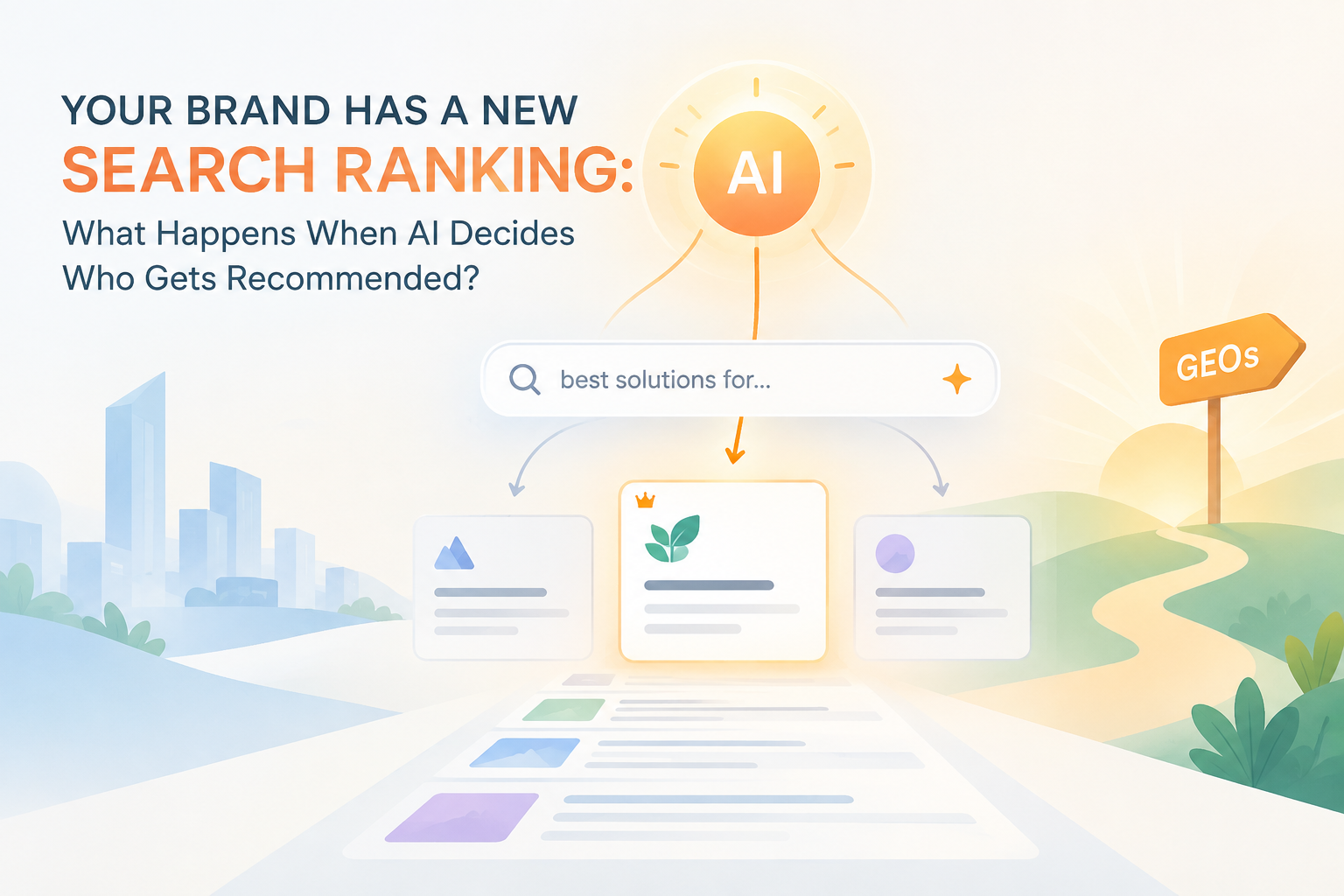
Picture a customer typing a question into an AI assistant instead of a search box. Something like: which project management platform works best for a fifty person marketing team that already uses Slack and needs client facing dashboards. The assistant does not return ten blue links. It returns three names, a short explanation of why each one fits, and a gentle nudge toward the one it thinks matches best. The customer reads the answer, asks one follow up question, and moves on.
Nobody searched. Nobody scrolled. A market that might contain forty legitimate competitors has been quietly reduced to three, and the customer never knew the other thirty seven existed.
That compression is the real story of AI mediated discovery. Traditional search ranking determined whether a customer could find you, rewarding signals a human could eventually audit: backlinks, keywords, domain authority. What is emerging now is stranger. It is not a position on a page. It is a probability, held inside a model and a retrieval system, that when a customer describes a need, the AI will understand your product well enough, trust it enough, and consider it relevant enough to say your name out loud. You cannot see this ranking on a dashboard. You can only infer it by asking the questions a customer would ask.
THE SEARCH YOU NO LONGER CONTROL
For two decades, Product Marketing operated on a stable assumption: somewhere between the customer's need and the company's product sat a search engine that returned a list, and the list could be influenced. Optimize the page, earn the links, win the click.
That assumption is eroding because a growing share of discovery now happens inside a conversation rather than a results page. Google's AI Mode passed one billion monthly users within roughly a year of its wider rollout, per the company's own I/O 2026 disclosures, with query volume described as more than doubling every quarter since launch. Google's AI Overviews reach an even larger audience, cited by the company at roughly two and a half billion monthly users by the same event. OpenAI reported ChatGPT crossed nine hundred million weekly active users in early 2026, with its own economic research estimating that shopping related questions make up a meaningful and growing share of daily queries.
None of this means links are dead. Google still handles most search volume, and plenty of transactional queries resolve the old fashioned way. But a widening slice of research heavy, "help me decide" queries are now being intercepted and answered before the customer reaches a results page. McKinsey research from late 2025 found that a plurality of AI search users already describe generative AI tools, not traditional search engines or retailer sites, as their primary source for product discovery. That is not a marginal shift in a marketing channel. It is a shift in who does the shortlisting.
THE DIFFERENCE BETWEEN BEING FOUND AND BEING RECOMMENDED
Product Marketers have spent years optimizing for discoverability, and it is tempting to assume the AI era simply raises the difficulty setting on the same game. It does not. Discoverability answers one question: can this system retrieve information about my product at all. Recommendation answers a harder set: does the system understand what the product actually does, who it is genuinely good for, can it distinguish the product from close competitors, and does it have enough credible evidence to state a preference with confidence.
A brand can be technically retrievable and still invisible in practice, because the AI mentions it inaccurately or buries it under a better documented competitor. A brand can be mentioned without being recommended, listed among several options without ever being the one the system leans toward. A brand can be recommended and still not selected, because the customer weighs a factor the AI did not surface. Each is a different failure mode requiring a different fix. Confusing them is why so much early GEO advice collapses into publish more content, which addresses discoverability while doing almost nothing for the recommendation problem underneath it. The question is not simply whether a system knows you exist. It is whether it has formed an accurate, confident, comparative opinion about you.
THE MACHINE TRUST LADDER
It helps to have a shared vocabulary for auditing this, so consider a simple structure: the Machine Trust Ladder. It has five rungs, and a product can fail at any one of them regardless of how strong the rungs above or below it are.
Existence is the base rung. Does the AI system's retrieval layer or training data contain information about the product at all, and is it current rather than stale. Comprehension sits above it. Does the system actually understand what the product does, in terms a customer would recognize, rather than a vague or partially wrong summary. Fit is the third rung. Given a customer's stated constraints, budget, team size, integration requirements, does the system understand who this product is genuinely built for, as opposed to who the marketing copy claims it serves. Credibility is the fourth rung. Is there enough independent, verifiable evidence, reviews, documentation, third party coverage, that the system can state a claim with confidence rather than hedging or omitting it. Action is the top rung. Can the system move from description to recommendation to a concrete next step: a comparison, a link, a completed purchase.
Most companies have invested almost everything in messages meant to move a human from awareness to interest. The Machine Trust Ladder asks something different: where does an AI system get stuck when it tries to reason about your product on a customer's behalf. A company can have outstanding traffic and brand awareness while stuck at Comprehension, because its public information is inconsistent, outdated, or too vague for a system to summarize with confidence.
THE INVISIBLE CONSIDERATION SET
In the old funnel, a company usually knew when it lost a deal. A demo went nowhere, a quote expired. Attribution was imperfect, but the loss itself was visible.
In an AI mediated journey, a company can lose a customer before that customer ever knows the company exists, and never find out it happened. The AI forms a consideration set, typically two to four options, based on its interpretation of the customer's intent. If your product does not make that set, there is no bounce rate to inspect, no abandoned cart. There is simply nothing, because nothing ever happened. This is why the most consequential Product Marketing failure of the next several years may be structurally invisible. A company can be doing everything right by every metric it currently tracks and still be quietly disappearing from the moment that decides whether it gets considered at all.
The progression worth internalizing is this: the competition used to be about ranking. It is becoming about inclusion, then about comparison, then about recommendation, then, underneath all of it, about trust. Each stage filters out companies the previous stage let through, and by the time a customer asks a follow up question, the field has usually already narrowed to a handful of names.
THE BLACK BOX PROBLEM
Traditional marketing analytics, for all their flaws, gave teams a legible chain of signals: impressions, clicks, conversion. AI mediated recommendation offers no equivalent chain today. A brand can know it was left out of an answer without knowing exactly why, because different AI systems use different models, retrieval architectures, product data sources, and commercial arrangements. There is no single universal ranking algorithm to reverse engineer, and any framework claiming otherwise is overselling certainty it does not have.
What can reasonably be said is that certain signals appear to matter across systems: accurate and current product information, independent evidence beyond the company's own claims, differentiation stated in specific, checkable terms rather than adjectives, and structured feeds that give a retrieval system something concrete to work with. None of these guarantee a recommendation. They simply remove reasons a system might hesitate or default to a better documented competitor.
GEO IS NOT THE NEXT VERSION OF SEO
It is tempting to treat generative engine optimization as SEO with a new acronym, optimize a page, add some schema markup, move on. That framing understates what is required. Traditional SEO optimizes a page for a crawler. Generative engine optimization, done seriously, means treating your entire public information ecosystem, website, documentation, pricing pages, customer reviews, third party coverage, as one interconnected system a language model draws from when explaining you to someone else. A single well optimized landing page cannot compensate for inconsistent pricing across five sources or a total absence of independent commentary about how the product performs. Writer's 2026 research on this shift makes a point worth repeating: generative engine optimization is overwhelmingly strategic, about positioning and earned authority, and only modestly technical.
PRODUCT INFORMATION IS NOW MARKETING INFRASTRUCTURE
This is where the emerging commerce protocols matter, and where the line between product operations and marketing genuinely dissolves. OpenAI's Agentic Commerce Protocol, built with Stripe, lets merchants push structured product feeds directly into ChatGPT, covering titles, descriptions, pricing, availability, and images, so the assistant can discover, describe, and eventually transact on a product without routing through a traditional search result. Google's parallel effort, the Universal Commerce Protocol, unveiled in January 2026 and expanded through the year, does something similar across AI Mode, Gemini, and, as of Google's May 2026 Universal Cart announcement, across Search, YouTube, and Gmail. Google is also adding new Merchant Center fields for conversational discovery, product question and answer pairs and compatible accessory information, so an assistant can answer a specific customer question accurately rather than guessing.
The completeness and accuracy of a product feed, historically an operations concern, is becoming one of the more consequential Marketing assets a company owns, because it is the raw material an AI system uses to decide whether it can confidently include and recommend the product at all. Get the feed wrong, incomplete pricing, missing availability, inconsistent naming, and no amount of campaign spend fixes the resulting gap.
WHAT PRODUCT MARKETING NOW OWNS
The traditional job of Product Marketing was translating product value into language a human buyer would find compelling. That job has not disappeared, but a second, less familiar job is stacking on top of it: making the product understandable and verifiable to systems that will describe it on the company's behalf, often without the company present to correct a misstatement.
Product Marketing increasingly needs answers to a different set of questions. Can an AI system accurately explain what this product does without oversimplifying it. Can it tell this product apart from its closest competitors without conflating them. Does it understand who the ideal customer actually is, as distinct from who the positioning deck claims. Is the pricing it would cite current. When a customer asks it to compare this product against a named competitor, does the answer hold up.
None of these questions has a single owner in most organizational charts today. Answering them requires Product, Marketing, Content, SEO, Data, and Sales to treat the company's public information as a shared, jointly maintained asset rather than several departments quietly publishing several slightly different versions of the truth.
THE TRUST PARADOX
It would be a mistake to treat AI visibility as an unambiguous good to be maximized. There is a genuine tension here worth sitting with rather than rushing past.
Should brands actually want to be recommended aggressively by AI systems, and at what cost. If enough companies begin writing content primarily to influence how a model describes them rather than to inform a human reader, the information ecosystem those models draw from starts to degrade, a slow contamination of the evidence base everyone, including the AI systems themselves, depends on. Consumer research already shows this tension is not theoretical. Optimove's 2025 trust research found that most consumers now assume AI is involved in their interactions with brands and are broadly comfortable with that, but comfort is conditional on the interaction feeling honest rather than engineered. If people conclude a recommendation was shaped by commercial incentives disguised as neutral advice, the damage lands on the platform and the brand together.
This is the argument for treating AI visibility work as an extension of factual accuracy, not a persuasion exercise aimed at a machine instead of a person. Making a product easier to understand accurately is different in kind from manipulating a system into a favorable answer it would not otherwise give. The first builds a durable asset. The second is a liability waiting for the moment a customer notices the recommendation did not match reality.
There is also a structural question worth naming: as more discovery moves inside platforms like ChatGPT and Google's AI surfaces, who ends up owning the customer relationship, and how does a company measure a sale that started with a conversation it never saw. OpenAI's protocol is explicitly designed to keep the merchant as merchant of record, and Google has made similar commitments around Universal Cart. Those are meaningful assurances, but they are also decisions made by two companies increasingly controlling the interface between customer and market, worth watching rather than assumed to hold indefinitely.
MEASURING WHAT YOU CANNOT CLICK
Website traffic, click through rate, and cost per acquisition were built for a world where the customer's journey left a trail a company could observe end to end. A conversation that happens entirely inside someone else's chat interface, ending in a recommendation the company never sees, breaks that instrumentation.
Teams experimenting in this space are beginning to develop rougher, more qualitative substitutes: an AI mention rate, tracking how often a brand appears across a representative set of customer questions; a recommendation rate, tracking how often it is favored rather than merely listed; a representation accuracy score, tracking how often the AI's description matches reality; and a competitive inclusion rate, tracking which competitors consistently appear alongside you. None of these are standardized industry metrics yet, and any vendor claiming otherwise is ahead of the evidence. They are useful less as dashboards and more as a discipline, a forcing function that makes a team look at what customers are actually being told.
RUNNING YOUR OWN RECOMMENDATION AUDIT
The most practical thing a Product Marketing and Product team can do this quarter does not require new tooling. It requires sitting down with the major AI systems a customer would use and asking the questions a real customer would ask, phrased the way a real customer would phrase them.
Ask what the AI knows about the product, unprompted. Ask which competitors it surfaces alongside it. Ask it to compare the product against the two closest alternatives and read for accuracy, not just favorability. Ask about pricing and see whether the answer matches what the website says today. Ask about a known limitation and see whether the system acknowledges or glosses over it. Change the customer's stated constraints slightly, smaller budget, different industry, and see whether the recommendation shifts in a way that makes sense.
This is not an exercise in figuring out how to game the system. It is closer to a customer experience audit conducted at a layer most companies have never inspected, the layer where a customer forms a first impression of the market before the company ever gets a chance to speak for itself.
THE SMALLER FUNNEL, THE BIGGER STAKES
Here is the paradox worth sitting with. The better AI systems become at narrowing a market down to a small, well reasoned set of options, the less room a brand has to directly influence a customer once that narrowing has happened. In the old digital funnel, a company controlled enormous amounts of the experience after the click, the website, the demo, the sales conversation. If AI increasingly filters the market before the click occurs at all, a meaningful share of persuasion has to happen upstream, in the public evidence base the AI draws from, long before any human conversation begins.
Counterintuitively, that should make Product Marketing more strategic, not less. It can no longer treat positioning as a message crafted for a launch deck and refreshed once a year. It has to treat positioning, documentation, and public claims as a living system read and repeated by machines every day, whether or not anyone on the team is watching. Product Management and Product Marketing, historically separated by who builds versus who explains, now share a single dependency: the product has to actually be what the public evidence says it is, because a language model has far less patience for a gap between claim and reality than a human buyer willing to give a brand the benefit of the doubt.
WHAT IT MEANS TO BUILD A BRAND NOW
Return to the customer typing a question into an assistant instead of a search box. Somewhere between that question and the three names the assistant offers back, a new kind of ranking has already happened, quietly, without a leaderboard, and often without the losing companies ever finding out they lost.
Building a brand in that environment means accepting that the most important impression a company makes may no longer happen on its own website, in a moment it controls. It happens inside someone else's answer, built from evidence the company left scattered across the internet, some accurate, some stale, some contradicted by a competitor's more current feed. The task is not to chase a ranking algorithm that does not exist in any single, discoverable form. It is to make sure that when a machine tries to explain your company to a customer on your behalf, it has the evidence to get it right.
REFERENCES
OpenAI, Buy it in ChatGPT: Instant Checkout and the Agentic Commerce Protocol, official announcement, 2026.
OpenAI Developers, Agentic Commerce Protocol documentation, developers.openai.com, 2026.
Digital Commerce 360, OpenAI reveals updates to its agentic commerce experience for ChatGPT, Brian Warmoth, March 24, 2026.
Google Developers Blog, Under the Hood: Universal Commerce Protocol (UCP), Amit Handa and Ashish Gupta, January 11, 2026.
Google, Google Shopping introduces Universal Cart, agentic shopping, official Google blog, May 19, 2026.
TechCrunch, Google's new Universal Cart wants to follow your entire shopping journey across the internet, May 19, 2026.
The Next Web, Google wants to own your entire shopping journey with Universal Cart and agent led payments, May 19, 2026.
Google, Universal Commerce Protocol updates improve AI shopping for retailers, official Google blog, April 7, 2026.
Harvard Business Review, How to Get AI to Surface Your Brand, June 2026.
Harvard Business Review, Stop AI from Eroding Your Brand, July 2026.
McKinsey and Company, consumer research on AI as a primary channel for product discovery, October 2025.
Gartner, Integrate AEO and SEO: Improve Online Search and Answer Engine Visibility, webinar series, 2026.
Writer, GEO, AEO, and SEO in 2026: The enterprise guide to AI visibility, July 28, 2026.
MarTech, 57 percent of consumers trust brands more when they use AI, study finds, February 2, 2026, citing Optimove 2025 AI Marketing Trust and Engagement Report.
Search Engine Land and Google I/O 2026 official disclosures, AI Mode and AI Overviews usage figures, May 2026.